Image
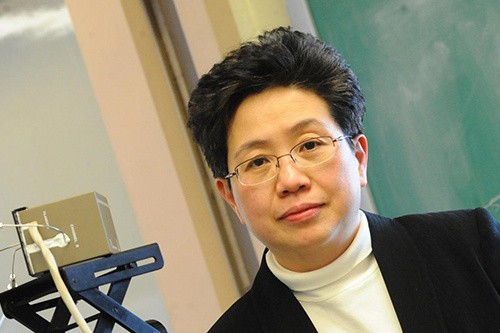
Siu-Wai Chan
Professor of Materials Science and Engineering
Siu-Wai Chan studies size-dependent properties of nano-ceramics and crystalline interfaces.
Chan’s research has focused on nano-ceramics and crystalline interfaces. Many working devices such as varistors and CMOS-FET's use novel electrical transport properties of grain boundaries and interfaces, respectively.
A part of Chan’s research studies the size-dependent mechanical properties of nano-ceramics which yields a fundamental understanding of ceramics in general. Another part identifies interfaces and boundaries that have exceptional electronic and electrical responses in order to exploit their uses in devices.
While many size-dependent electronic and optical properties of nanoparticles have been thoroughly studied, basic properties such as compressibility and bond lengths have been neglected. Recently, we have used the diamond anvil cell to study the “bulk modulus” as a function of the size of nano-oxides and have found a trend that needs to be addressed fundamentally. Bulk modulus and bond lengths are some of the fundamental properties. Understanding the size-dependent trend will help us to better understand materials in general.
Chan received a BS in materials science and metallurgy and the Francis B.F. Rhodes Prize from Columbia Engineering. Chan earned a ScD in materials science and metallurgy from Massachusetts Institute of Technology. After being a staff member of Bell-Labs in NJ, Chan came back to Alma Mater as an associate professor and became co-chair of the Solid State Program in 2001. Chan lectured and conducted research at Nanyang Technological University in Singapore under the Tan Fellowship, at University of Washington as an Advance Fellow, and at University of California, San Diego, as a Guggenheim Fellow. Chan received Presidential Faculty Fellow from President Bill Clinton and faculty research award from IBM, DuPont, and BASF. Chan was a visiting scientist at the IBM Watson Research Lab, NIST Boulder CO, and Bitter Magnet Lab, MA. She is the holder of six U.S. patents.
Research Areas
- Materials for Energy
- Materials for Environmental Applications
- Materials Synthesis and Processing
- Nanomaterials
- Biomaterials
- SiGe BiCom Misfit Dislocation Avoidance
- Ceramic Superconductors
- Grain Boundaries and Interfaces
Additional Information
-
Professional Affiliations
- American Ceramic Society
- American Chemical Society
- ASM International
- Association for Iron & Steel Technology (AIST)
- Materials Research Society
- The Minerals, Metals, Materials Society (TMS)
- American Physical Society
- Society of Women Engineers
- International Committee of Diffraction Data
-
Honors & Awards
- Fellow of American Physical Society, 2018
- Avanessians Diversity Award, 2012
- BASF Catalysis Research Award, 2008-2011
- American Ceramic Society Fellow, 2008
- Advance Fellow: National Science Foundation/Univ. of Washington, 2004
- Tan Chin Tuan Fellow, 2004
- Guggenheim Fellow, 2003
- IBM Faculty Award, 1998
- Outstanding Woman Scientist Award, 1997
- Presidential Faculty Fellow from the White House and the National Science Foundation, 1993
- Very Important Parent: Luther Lee Emerson School in Demarest, NJ, 1992
- DuPont Faculty Award, 1991, 1992
- Sigma Xi, 1982
- Tau Beta Pi, 1979
- Columbia Univ. SEAS Francis B.F. Rhodes Prize 1980
-
Professional Experience
- Professor of materials science and engineering in the Department of Applied Physics and Mathematics, Columbia Engineering, 2002 –
- Co-chair of the Solid State Program, Columbia Engineering, 2001 –2005
- Executive committee member and outreach director, Materials Research Science & Engineering Center, 1998-2009
- Associate professor of applied physics and applied mathematics, Columbia Engineering, 1998 – 2000
- Co-chair of Materials Science and Engineering Program and Committee, Columbia Engineering, till 1999
- Associate professor of chemical engineering and materials, 1993 – 1998
- Associate professor of metallurgy and materiais, 1990 – 1993
- Visiting professor of materials, as Tan Fellow, Nanyang Technological Univ. (Singapore), 2004
- Visiting professor of materials science and engineering, as National Science Foundation 2004 Advanced Fellow, University of Washington.
- Visiting professor of physics, Guggenheim Fellow, University of California San Diego, 2004
- Visiting scientist, IBM Watson Research Lab, 1999
- Visiting scientist, Bitter Magnet Lab, 1993 – 1996
- Member of technical staff, Superconductors, and Surface Modifications to solve the last-mile-problem, Bell-Labs & Bellcore, Murray Hill, NJ, 1985-1990
-
Education
- ScD, Materials Science, Massachusetts Institute of Technology
- BS, Metallurgy and Materials Science, Columbia Unversity